

Where to Buy Fresh Roasted Coffee: A 2026 Guide
Table of Contents
- Why Fresh Roasted Coffee Beats Grocery Store Shelves
- Where to Buy Fresh Roasted Coffee: Your Best Options
- Coffee Roast Date Importance: Why That Number Matters
- How to Tell If Coffee Beans Are Fresh
- The Science of Degassing: What Happens After Roasting
- How to Store Coffee Beans for Maximum Freshness
- Subscription vs. One-Time Orders: Which Fits Your Routine
- Sourcing, Origin, and What You're Paying For
- Frequently Asked Questions
Last Updated: September 15, 2026
Why Fresh Roasted Coffee Beats Grocery Store Shelves
Grocery bags stamped with "best by" dates months out tell you nothing about when the coffee was roasted, the single biggest factor separating vibrant coffee from stale. This guide from Madoli Coffee explains where to buy fresh roasted coffee, how to verify it, and how to keep it tasting sharp.
Coffee is an agricultural product, not a shelf-stable commodity. Once beans leave the roaster, oxygen, moisture, heat, and light degrade the oils and aromatics that create flavor. Most grocery coffee sits in warehouses for weeks or months, so the peak flavor window has closed by the time you brew it.
"Freshness isn't a marketing angle. It's the difference between tasting a coffee's actual character and tasting what's left of it.", Madoli Coffee roasting team
The fix: buy from roasters who prioritize freshness. Below we cover your best options, how to read a roast date, and how to store beans so the last cup tastes as good as the first.
Where to Buy Fresh Roasted Coffee: Your Best Options
The two reliable paths to genuinely fresh roasted coffee are local roasteries and online direct-to-consumer roasters. Both let you verify roast dates before you buy, which grocery shelves rarely allow.
Local Roasteries and Cafes
Buying local gives you the shortest gap between roast and brew. Many small roasteries roast weekly or daily and will tell you the exact roast date if you ask. You can smell the beans, check the bag for a printed date, and buy in quantities sized to your consumption.
The trade-off is selection and consistency. A small roastery may carry only a handful of single-origin offerings at a time, and inventory rotates with the harvest calendar. If you find a flavor profile you love, it may not be available next month.
Online Roasters and Direct-to-Consumer Shops
Online roasters solve the selection problem: order single-origin beans in one cart, and most reputable online roasters print the roast date on every bag.
The catch is shipping time: ground shipping adds two to five days, so factor that into your freshness math and prioritize roasters who ship quickly and offer tracking.
| Option | Typical Freshness | Selection | Best For |
|---|---|---|---|
| Local roastery | Days after roast | Limited, rotating | Immediate consumption, hands-on buying |
| Online direct-to-consumer | Days after roast, plus shipping | Wide, multi-origin | Variety, convenience, gifting |
| Grocery shelf | Often weeks to months | Broad but stale | Emergency backup only |
Coffee Roast Date Importance: Why That Number Matters
The roast date is the most honest freshness signal on a bag. Unlike a "best by" date, set conservatively and often far in the future, it tells you exactly when the clock started ticking on flavor, and for online buyers who can't smell the bag first, it's the only reliable quality control.
Beans begin losing aromatic compounds within days of roasting. The peak window for most runs roughly four to fourteen days post-roast, depending on roast level and brew method; light roasts hold up slightly longer because darker roasting drives oils to the surface, where they oxidize faster (pubmed.ncbi.nlm.nih.gov).
How to Read a Roast Date on Packaging
Roast dates appear in several formats, and misreading one is easy:
- "Roasted on" vs. "Best by": Only the first is a roast date. A "best by" date is a shelf-life estimate, often set 6-12 months out, and tells you nothing about when the beans were roasted (usda.gov).
- Date format ambiguity: Most roasters print month/day/year (e.g., 09/15/26), but some use day/month/year. If the numbers are ambiguous, check the roaster's website or the bag's fine print for a legend.
- Julian or batch codes: Some larger operations print a batch number or Julian date (day of year) instead of a calendar date. These require a decoder, often posted on the roaster's site, and are a yellow flag for a buyer who wants transparency.
- Stamped vs. printed: A crisp printed date is standard for roast-to-order shops. A smudged ink stamp or a sticker applied over an older date is a warning sign.
- No date at all: Treat this as a dealbreaker. Roasters proud of their freshness print the date prominently.
A Quick Verification Checklist
Before you add a bag to your cart, run through this:
- Is there a printed roast date, not just a "best by" stamp?
- Can you confirm the format (month/day/year) so you don't misread it?
- Does the bag have a one-way degassing valve, which signals the roaster expects active off-gassing?
- [ ]
- If ordering online, will the bag arrive within the peak window (roughly 4-14 days post-roast)?
A roast date you can read and trust beats any "freshness guaranteed" label, it's the one number that lets you do the math yourself.
How to Tell If Coffee Beans Are Fresh
Fresh whole beans look slightly matte with visible surface oils on darker roasts, smell intensely aromatic when the bag opens, and feel firm rather than brittle. Stale beans look dull, smell flat or papery, and crumble easily.
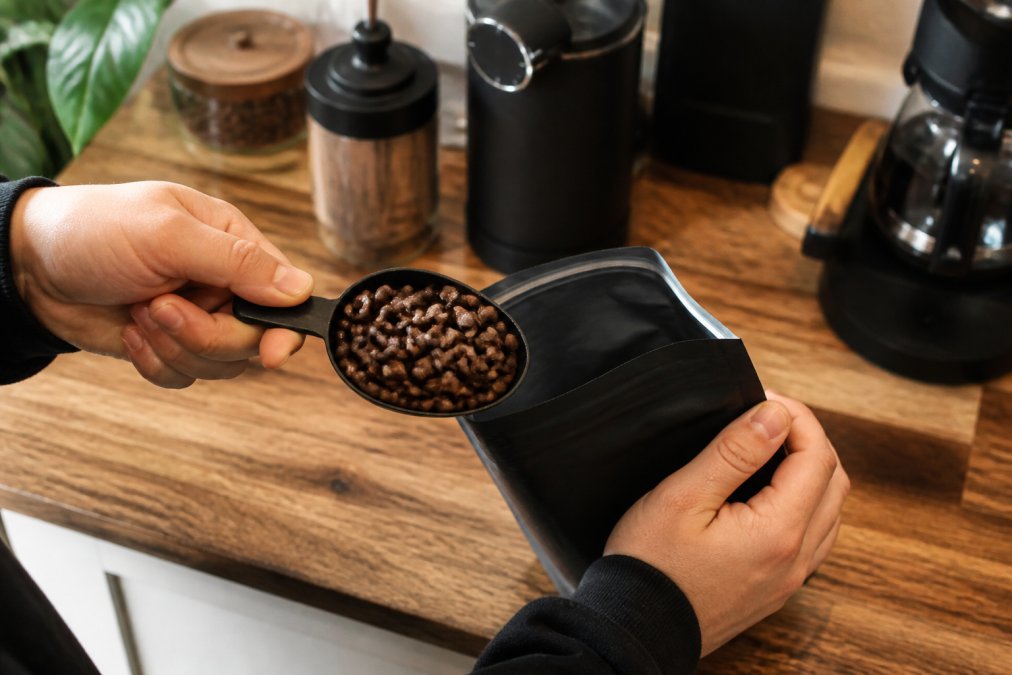
A few practical tests help you judge freshness before you brew:
- Smell test: Fresh beans release a strong, complex aroma. Stale beans smell like cardboard or nothing at all.
- Sound test: Fresh beans crackle faintly when you pour hot water over them, a sign of trapped carbon dioxide escaping.
- Crema test: Espresso from fresh beans produces thicker, more persistent crema than stale beans.
Whole bean stays fresh noticeably longer than pre-ground: grinding exposes far more surface area to oxygen, so ground coffee can lose peak flavor within days (pubmed.ncbi.nlm.nih.gov). Buy whole bean and grind just before brewing.
The Science of Degassing: What Happens After Roasting
Degassing is the release of carbon dioxide trapped inside beans during roasting. Heat and pressure build gases inside the bean's cellular structure; once it cools, those gases escape slowly through tiny pores for days or even weeks, depending on the bean.
This is why freshly roasted beans need a one-way valve: it vents carbon dioxide without letting oxygen in. A bag with no valve will balloon or trap gas against the beans; a valve is doing real work, not decoration.
Why Degassing Matters to Your Cup
Too much trapped gas interferes with extraction: when hot water hits a heavily off-gassing bean, escaping carbon dioxide pushes water away from the grounds. The result is uneven extraction, some grounds over-extract, others under-extract, and the cup tastes flat, sour, or muddy even though the beans are technically "fresh."
The Resting Window by Brew Method
How to Tell When Beans Have Rested Enough
How to Store Coffee Beans for Maximum Freshness
Subscription vs. One-Time Orders: Which Fits Your Routine
| Factor | Subscription | One-Time Orders |
|---|---|---|
| Best for | Daily drinkers, routine buyers | Occasional drinkers, explorers |
| Convenience | High, automatic delivery | Manual, order as needed |
| Flexibility | Depends on pause/cancel terms | Complete control |
| Risk | Overbuying, unwanted roasts | Running out between orders |
Sourcing, Origin, and What You're Paying For
Frequently Asked Questions
What is the best way to verify a coffee's roast date before buying?
Look for a printed roast date on the bag, not just a best-by date. Reputable roasters stamp the exact day beans were roasted. If a bag only shows a best-by date months out, the beans are likely older. For fresh roasted coffee, order from roasters who roast to order. Ask about their roast date policy before purchasing.
How long do fresh roasted coffee beans stay fresh after opening?
Whole bean coffee peaks in flavor between 4 and 14 days after roasting. After opening the bag, aim to use beans within 2 to 3 weeks for best taste. Ground coffee stales much faster, often within days. Store beans in an airtight container away from light, heat, and moisture. A vacuum-sealed bag helps before opening, but once exposed to air, the freshness window shrinks quickly.
Can I buy fresh roasted coffee without committing to a subscription?
Yes. Many online roasters let you place one-time orders with no subscription required. You choose the beans, quantity, and shipping speed. Some offer optional subscriptions with flexible delivery frequency, but you can skip or cancel anytime. If you prefer to buy only when you need beans, look for a roaster that clearly states no auto-ship or hidden charges.
What is the difference between roasted-to-order and store-bought coffee?
Roasted-to-order coffee is roasted after you place your order. Store-bought coffee may sit in warehouses or on shelves for weeks or months before you buy it. That gap affects aroma, acidity, and body. Fresh roasted coffee retains more of its natural flavor profile because it hasn't spent weeks degassing in a distribution chain.
Freshness is the one variable you can control, and it changes everything about how your coffee tastes. At Madoli Coffee, we roast in small batches and ship whole bean coffee with clear roast dates, so you know exactly what you're brewing. Explore our single-origin offerings, build a one-time order or a flexible subscription, and pair your beans with our brewing accessories and apparel. Get started with Madoli Coffee and taste what fresh roasted coffee is supposed to be.